
FREQUENTLY ASKED QUESTIONS
What is Felt?
If you’ve reached The Gentle Roller website, it’s likely you’ll already know what felt is – and we’re not referring to industrial felt but ‘artisan felt’.
But if you are just browsing and would like an introduction the term felting refers to taking animal fibres and working them through a process of adding water, soap and agitation to convert it into a tightly cohesive fabric. The fibres are most often sheep wool but also alpaca, mohair, angora, camel, yak and some other furs. These fibres have a barbed or scaled surface texture. More or larger fibres felt best (sheep wool) while fewer or smaller barbs are more difficult (mohair).
Animal fibres will felt: plant and man-made fibres do not (although they can be incorporated into a felted item).
If you are making nuno felt ie merging wool or other fibres onto a carrier fabric (silk/cotton), you need to get the fibres to migrate through the fabric. Felting is NOT reversible.
The goal of good felt making is to control the agitation to create a consistent and even felt.
There are a wide variety of felts to suit a wide variety of applications. “Industrial” felt is employed in applications such as sound deadening in cars, whereas “artisan” felt is highly sought after by the fashion industry.
Artisan felt is typically made by placing the required wool and or other materials onto a flexible sheet of plastic film (or other suitable material). The materials are laid out by hand to form a desired aesthetic. There are several methods for rolling felt but the Gentle Roller felt rolling machine uses the method where once the material and design has been artistically laid out, it is wetted down and then overlaid by a further sheet of plastic film. This sandwich construction is then wrapped about a suitable carrier (in our case the drive roller) and then secured in place on the roller. Elastic band or other suitable restraint are usually quite functional.
Without the aid of a rolling machine, the wrapped bundle is then rolled on a tabletop to agitate the material.
From time to time the artisan will inspect the material wrapped about the roller, and potentially vary the amount and location of the pressure that they apply there to achieve the desired degree of felting in the desired locations, e.g. to achieve uniform felting.
Selecting and laying out the material is skillful and rewarding, whereas the rolling is hard work. By way of example, producing an item featuring superfine merino and silk fibres, and silk carrier, can entail up to 6,000 full rotation rolls of the roller. Larger items require more rolling. Producing a coat formed of artisan felt can entail in excess of 40,000 rolls. Whilst the production of artisan felt is a rewarding craft that produces beautiful results, many artisans give the craft away simply because the rolling becomes too hard for them. Accordingly, attempts have been made to automate the rolling process. These machines are typically industrial, expensive, not pleasing to the eye, do not give the user control over the process and don’t replicate the hand crafted felt process.
The Gentle Roller wet felting machine has been designed to overcome all the shortcomings of earlier machines and reduce the back-aching work of manual rolling and give the felt maker time to concentrate on the important aspects of their craft.
The Gentle Roller wet felting machine truly is the felt makers friend.
What is a Fulling Drum?
The Gentle Roller exclusive Fulling Drum
The production of felt can be considered a three-part process;
1. The laying of your materials, which is a discrete activity. Historically, the basic raw material is woolen fibres or fleece. Wool fibres have a barbed or scaled surface texture which make them ideal for felting.
Sheep fibres have the most barbs making it the easiest fibre to felt, but almost all animal fur or fleece can be successfully felted. Alpaca, goat, rabbit, yak and camel are all popular fibres that can all be felted but with increasing levels of difficulty as the barbs become fewer or smaller.
Your laying may also include the introduction of a carrier fabric (usually silk or cotton). Here you need to get the fibres to migrate through the fabric in order to attach it and incorporate it in the ‘felt’. The use of a carrier fabric is known as Nuno felt.
Finally, your laying may include embellishments like silk strands, which do not felt, but whose fibres are captured by the wool (or other animal) fibre to become part of the finished item.
2. Next comes the rolling of the materials to a pre-felt.
During pre-felting, the goal is to open the barbs of the fibres, usually with a high pH soap solution, twist and tangle the fibres together by sliding them against each other with the aid of a felting solution and light agitation, embed them through the carrier fabric (if nuno felting), or entangle them in the embellishments.
The goal is not to shrink the materials but to ensure good meshing of the component parts.
The Gentle Roller uses the rolling process to create the pre-felt.
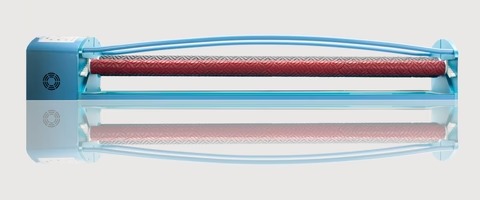
The Gentle Roller wet felt rolling machine
The material may shrink very marginally as the fibres start to become entangled and matted together into a cohesive piece of material, and in nuno felt, the fibres migrate through the carrier fabric.
The more rolling you do, the more entangled and cohesive your pre-felt becomes. Poor quality pre-felt will fall apart on drying while good quality pre-felt can be gently handled and cut into shapes for future felting.
Good quality pre-felt is the precursor to good quality felt.
3. To make the finished felt you then need to “full” your material.
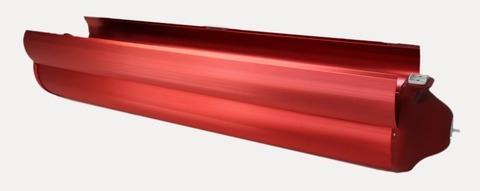
In reality, pre-felting and fulling are a part of a continuum. When to stop the gentler rolling / meshing / pre-felting, and when to start more aggressive shrinkage / fulling, are personal choices and depend on your objectives and familiarity with the materials.
Ultimately, when you have happily pre-felted and fulled your material to a suitable final quality and size, you have a “felted” item.
How long does it take to deliver?
After you order it usually takes 3-6 working days to arrive at your country anywhere in the world. Local delivery then takes another 2-3 working days.
What payment method and currencies can I use?
We only accept USD payment made via credit card.
Direct Deposit: If you want to pay by direct deposit, just ask us how.
What if something goes wrong with my GR? How do I get it repaired?
You don’t need to get your Gentle Roller repaired; you can do it yourself.
If anything should go wrong we want to work with you to make sure your Gentle Roller functions as described and is in full working order.
The Gentle Roller has been designed with minimum moving parts, a robust design and minimum potential for failure. If something does go wrong, our goal is to help you fix it and get your Gentle Roller up and running in the shortest possible time.
Any failures are readily fixable with a replacement part and basic tools.
The Gentle roller was deliberately designed and engineered so that the whole thing can be assembled with one screw driver and one Allen key (provided), by anyone who knows how to use a screwdriver.
It was also ‘over-engineered’ for the job it was designed to do so that most parts wouldn’t wear out or break under heavy loading. This wasn’t an accident. It took two years of design and engineering reviews so ensure it was ‘just right’ and anyone, anywhere, could build, repair or replace parts with minimum of fuss.
Should you have any issues with your Gentle Roller please contact us in the first instance at info@gentleroller.cn or albert_wang97@126.com
We will be happy to work with you to resolve the issue.
We have very, very few quality problems. To back that up, we have a 3yr or lifetime guarantee against faulty material or workmanship affecting the operation of The Gentle Roller.
How does The Gentle Roller work?
It works the same way as hand rolling your felt on a pool noodle or similar object. When you hand roll, the felt is agitated between the pool noodle and the surface you are rolling on. With The Gentle Roller, the felt is agitated between the drive roller and the two or three idle rollers.
What control do I have with The Gentle Roller?
When felting, there are four key control functions and each have default min/max settings.
Speed: You control the speed from 50% to 100% of maximum motor speed (Max approx 100 RPM). The default start speed is 50%
Cycle Count: You control how many cycles, or rotations of the drive roller, you would like to do from 50-10,000 before The Gentle Roller stops. The default cycle count is 1000 cycles (Equal to about 130 full length manual rolls)
Forward Rotation: You control the number of forward rotations of the drive roller from 0.5 to 3.0 rotations. The default setting is 2.0
Reverse Rotation: You control the number of reverse rotations of the drive roller from 0.5 to 3.0 rotations. The default setting is 2.0.
The importance of these settings will become more obvious as you watch the tutorials and become familiar with what works best for your style of felting.
Is using The Gentle Roller better than hand rolling?
That’s a matter of how well you use The Gentle Roller. We like to say that The Gentle Roller is as nuanced as you are as a felt maker.
What we can also say is that regardless of your experience level as a felt maker, The Gentle Roller will give you more consistent felting than hand rolling because whatever set-up you choose is repeated over and over – The Gentle Roller never tires as you will when you do it by hand.
Can I say my item is still handmade?
Handmade is an interesting concept that some would argue is virtually unachievable.
Putting that extreme position aside, I’ll begin with a comment by BigCommerce.com, “Some online communities state that the terms “hand-assembled,” “handcrafted” and “hand-altered” are acceptable and synonymous with handmade. Those words insinuate that though the fundamental materials weren’t built from scratch, the seller has added his or her own twist to the product.
The recurring issue with the term “handmade” is that some crafts incorporate both hands and machinery during crafting. For example, a garment made with store-bought fabric and sewn on a sewing machine might be considered handmade by some, but not others. Woodworking is a very hands-on process, though it typically includes a variety of tools that make the final products possible.”
Now my own slant.
Michelangelo couldn’t have carved David without hammers and chisels and a crane to pick it up. But David was surely his! Pollock couldn’t have painted half his works without a trapeze to suspend him – he had tools that were not handmade, but the work was surely his! No one quibbles about David being made by the hands of Michelangelo, or Blue Poles being made by Pollock’s own hand.
Handmade silk cloth is woven on a loom, so are handmade carpets, a tailor has a sewing machine, a print maker uses a press, a potter uses a wheel, a jeweller uses a diamond cutter and a soldering iron … and I could go on. Then there are the input raw materials, are they handmade?
Every craft has its raw materials and its tools, yet the output of the skilled craftsperson is (usually) considered handmade. The underlying reason for this is the product’s uniqueness, the possibility of flaws or errors and the fact that no two items, however hard you try, are exactly the same.
The Gentle Roller is a tool for felt makers. The work is the work of the felt maker alone. No two pieces are ever the same. The finished item is as handmade as any other artistic endeavour … and I could add, as handmade as Michelangelo’s David or Pollock’s Blue Poles.
Can I roll in one direction only?
While we recommend two-way rotation there are certain circumstances when one way rotation is preferable. All the standard settings (see Q: What control do I have?) can be changed by the user. By changing forward or reverse rotations to zero The Gentle Roller will roll in one direction only.
It is our experience that oscillated rolling (patented) produces better felt than one direction rolling as it is the agitation that induces the felting action.
Will it work with my power supply?
The power pack is approved for Australian, USA, UK and EU standards and will come complete with a plug most suited to your address.
It is a 24V DC, 2 Amp power pack (using max 48 watts)
I know that the idle rollers are gravity held in place and there is no entrapment hazzard, but what about the worst-case scenario, what if something did "get stuck"?
Don’t worry. The PCB board has a built-in torque over-ride function. If the drive roller is interfered with or becomes “stuck” or “jammed” in any way the PCB senses the stress on the motor and will simply switch off, stop the machine and reboot back to the main menu function.
The power over-ride won’t interfere with your felting but is at a low enough setting that no injury could occur before it engages and closes down the motor.
Will the Gentle Roller felt every type of fabric?
The honest answer is NO.
But so far there is only one fabric we have had problems with.
There is a material known as Devoré (also called burnout). Devoré techniques uses blended fabrics which combine protein-based fibres such as silk with cellulose-based fibres such as viscose, cotton, or rayon, in order to create the ‘burnout’ pattern.
The Gentle Roller can felt Devoré with silk and cotton, and viscose and rayon provided they are not treated for waterproofing.
However, there are cheap copies of the Devoré process available in fabric retailers, typically called “burnout fabric” which are definitely not silk. Some are made with a blend of viscose and polyamide.
The viscose is the velour type material – this absorbs water which is good. The main mesh fabric though is polyamide – it is waterproof at worst and water resistant at best and it won’t hold or carry water.
When you try nuno felt using a carrier fabric that is a waterproof mesh material like polyamide, especially with a fine weave, the water gets pushed aside – it doesn’t want to go near the polyamide – there is no ‘wicking’ effect – and the water takes the wool with it resulting in clumping of the wool.
Polyamide is an interesting material because you can felt with a blend of woollen and polyamide fibers, but usually the blend is 5%-10% and a maximum of 20% polyamide. The polyamide doesn’t actually felt, it just gets tangled in the woollen fibres.
But you cannot felt onto a polyamide mesh (or probably any mesh that is water resistant or water proof and has no ‘wicking’ effect.)
How noisy is a Gentle Roller?
It’s as quiet as a library. See video under the Other Things video section.
How big is a GR1400 when assembled?
Bench Space Required: 165cm L x 36cm W x 25cm H (plus hand access).
It weighs less than 28kg when all rollers are loaded or the fulling drum is in use.
How big is a GR1100 when assembled?
Bench Space Required: 135cm L x 36cm W x 25cm H (plus hand access)
It weighs less than 24kg when all rollers are loaded or the fulling drum is in use.
How big are the GR1400 cartons?
Carton Sizes:
Roller housing and Drum Panels:
Size: 149*39*23cm,
weight: 27.5kgs
Drum components:
Size: 26*24*23cm,
Weight: 1.5kgs
Motor housing:
Size: 38*22*30cm,
Weight: 6.5kgs
How big are the GR1100 cartons?
Carton sizes:
Roller housing and Drum Panels:
Size: 119*39*23cm,
weight: 22kgs
Drum components:
Size: 26*24*23cm,
Weight: 1.5kgs
Motor housing:
Size: 38*22*30cm,
Weight: 6.5kgs
I'm worried about dealing with customs clearance. How does Customs and VAT/TVA get handled?
Customs: There is (almost) nothing that you need to do.
The usual method is as follows. We send a commercial invoice and customs documentation with the goods. When the carrier (usually Fedex) receives the documents they lodge it with Customs for calculation of VAT/TVA.
Sometimes this happens while the goods are in transit – sometimes when the goods arrive. Your government Customs Department will calculate VAT/TVA based on the documentation and advise Fedex to collect the VAT funds.
Fedex will advise you of the amount due and where to pay. You make payment. Fedex make the delivery.
Here is all you need to do: With any overseas purchase, you are considered the importer. If your government has a VAT/TVA/GST you need to pay the required tax, and if you are not already registered with your government as an importer, you will need to obtain an import/tax number.
FedEx will need your import or taxation number for the Customs documentation. You should apply for the number as soon as you have placed your order, and if you advise us, we will confirm it with Fedex.
USA customers need to advise within 48 hours a company name or a personal social security or taxation number. Plus confirm that they are willing to pay the Tariff on arrival which may be as high as 80% or more. This is USA government requirement. If you do not advise as above your order may be cancelled and refunded less non-refundable credit card payments.
NZ customers need to complete a customs request and obtain a customs number. This is easy and we will send you a link to the customs form when you place your order. You should apply for the number as soon as you have placed your order, and if you advise us, we will confirm it with FedEx.
UK/European customers need to obtain an EORI number. As the forms vary by language/country you need to obtain the correct form or apply online with your Governments Customs Department. Again, the form itself is simple to compete and usually takes around 15-20 minutes. You should apply for the number as soon as you have placed your order, and if you advise us, we will confirm it with FedEx.
CAD/Aust: No action is required. Tax is payable in some cases but specific action is not required on your part unless requested.
Notes for Eastern European/South American nations:
Customs Inspection: On rare occasions (1%) Customs want to receive the cartons and open them for inspection to check the contents and check if the correct HS Tariff codes have been used. This is not a problem and usually means an extra delay of a few days to complete the delivery. It depends entirely on how busy customs are and what they do, there is no way we can speed this up. It is usually an issue for Eastern European countries and rarely occurs with Euro nations.
Customs Price Check:
Most Customs Departments accept the value of our commercial invoice (which
is with the goods) to calculate the outstanding VAT/TVA. On very rare occasions, again, usually only Eastern European or South American countries, they will ask the customer to provide proof of payment ie a bank deposit statement or receipt to confirm the payment has been made to us. They will use the actual payment figure for their VAT/TVA calculations.
Where Can I Find an Agent or Dealer
We don’t have agents or dealers anywhere. We have tried but it only adds cost and higher administration.
All of our customers simply order direct. It is safe and secure.
You may not be convinced by our Testimonials (of which we have hundreds).
So, use your own eyes and look at the hundreds of items in the image gallery and the video gallery . If your own eyes don’t convince you, then you won’t be convinced by an agent showing you the same things.
Firm Feel Drive Roller vs Soft Feel Drive Roller
The firm feel comes as standard and will do anything, but is particularly useful for heavier items, like a coat or sleeved top or any garment that needs a resist and folding to fit on the roller.
If you are folding a garment with a resist you need to roll at least 4 layers of wool, 2 resists, and probably 4 layers of the outer fabric. It’s quite thick and heavy. When I designed the GR it was the basis for the original drive roller. Later it also proved to be very successful for doing wool rugs, or woollen fleeces when doing ‘eco’ sheep fleece rugs.
Soon after launching the GR, we turned to lightweight scarves and wraps – 15gm of wool, laid on 3mts of fine mesh silk. While they could be done on the Firm Feel Drive Roller, it didn’t seem to be the best solution. Bubble wrap proved a useful way for turning a Firm Feel Drive Roller into a de-facto Soft Feel Idle Roller (there is a video on that), but it wasn’t efficient to keep changing from a Firm to a Soft Drive Roller.
So I experimented with softer PU foam and came up with the Soft Feel Drive Roller. The sponginess of the foam roller allowed for easier migrating of wool thru silk, thus being quicker than the Firm Feel roller. Plus, the softer roller gave softer finish to the lightweight wool, it had less movement of embellishments and it was also a significantly lighter roller to handle.
Bottom line, if you are doing thick felt layers or very heavy felts or felts with a resist, use the (grey) Firm Feel Drive Roller. If you are doing very fine, light weight items, use the (purple) Soft Feel Drive Roller.
So, thick/heavy felts, wall arts, multi layered garments, something with a resist, rugs. etc use heavy = Firm Drive Roller;
Thin, light weight felts = Soft Drive Roller
Is the GR Chinese?
No, it isn’t. It’s Australian. It is a product designed and specified by an English born, Australian naturalized person – me, Philip Coates. I designed all the components, sourced and approved all the tooling, and for the first few years I even did the assembly albeit in Guandong China.
It is assembled and stored in China as that is the way to achieve the cheapest global distribution costs. And we all want the cheapest cost. Because it ‘ships’ from China, most countries consider it Chinese origin for the purposes of nominating an import status. They don’t look beyond the point of departure – China.
But the revenue goes to Australia (gentleroller.com.au), various Australian suppliers, China (gentleroller.cn), various Chinese parts manufactures, FedEx (a USA freight company), multiple airlines depending on destination, and the purchasing country by way of VAT/Tariffs/Duties/etc.
Only about 25-30% of the cost of the GR remains in China, the rest is shared globally. A USA company probably takes the biggest portion.
So, is it Chinese? No. It will always be Australian by birth, international by nature.
Like the pace-maker, the cochlear ear implant, wi-fi, ‘google’ maps, the combine harvester and many, many more Australian inventions, including the humble Esky, these and the Gentle Roller are all Australian products, shared internationally.
How Long Can my Felt be?
It depends on what thickness your layers are when wet down.
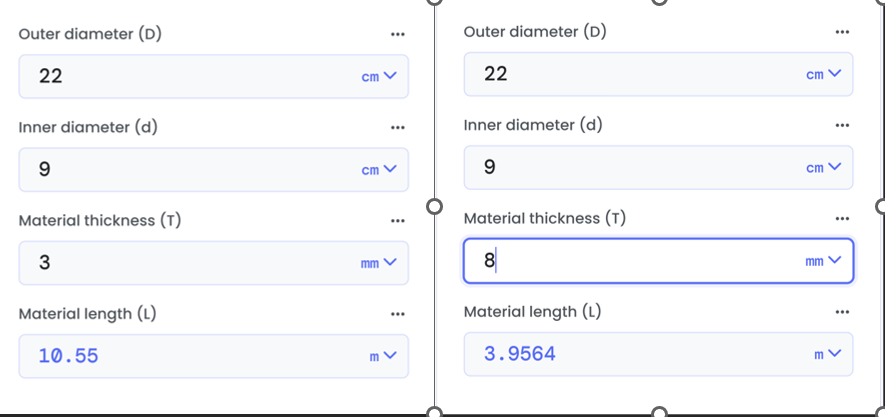
Using this little calculator https://www.omnicalculator.com/everyday-life/roll-length you can work out whatever combinations of thickness and length you want to achieve.
The firm roller is 9cm inner diam.
The max outer diameter is 22 cm.
In theory you could roll a 10.6 meter length if it was only 3mm thick, or about 4 meters if it was 8mm thick.
In practical terms we would recommend a maximum of 3.5mt length is more than enough for most needs, and this will require several false end cycles to avoid it being soft in the middle.
Can You Summarize the GR Model Options
The Gentle Roller essentially comes in 2 sizes 1100mm roller and 1400mm roller, and three model types;
GR1100 / GR1400 – the most basic model is just the rolling machine. We don’t recommend this model, and we only have it in the range as a comparison with our competitors as that is all they sell – rolling machines. You still need to full (shrink) your work which may be easy if you are doing a scarf, but can be very tiresome if doing a garment or heavier/larger piece.
We sell only a few per annum and mostly to customers who already have a GR and all the accessories, and they just want another basic machine that can roll.
GR1100FD / GR1400FD – this model includes the fulling drum. The Gentle Roller is the only felting machine to offer a unique fulling drum with two accessory fulling bags. Highly recommended to complete the fulling of your pre-felt. Read here: What is a Fulling Drum?
It is also possible to make items like shoulder bags and hats, by rolling only in the fulling drum and not using the rollers at all. There are demos on this in our exclusive pages for owners.
GR1100FD+SF / GR400FD+SF – this model has the fulling drum plus an accessory soft feel drive roller. The soft feel drive roller was developed for light weight items and very fine felts. It is slightly quicker to felt compared with a standard firm feel roller and it provides a slightly softer finish. If you are making wall art it isnt that important, but if you a making a very fine lightweight scarf it provides a better product.
SF – Soft Feel Drive Roller. The very popular Soft Feel Drive Roller. The softness of the polyurethane compound provides a cushioning effect under the felt bundle and gently increases the agitation of the fibres thus aiding the felting process. (Please read The Benefits of a Soft Feel Drive Roller)
Purchasing the soft feel drive roller at the same time as your Gentle Roller saves you money as we can pass on the freight savings.
We recommend that customers buy the GR1400FD+SF (or smaller GR1100FD+SF) as it allows them to make any type of felt they want. You may only make one style at the moment – but having the full GR opens up a whole world of new opportunities.
Freight is already included in the price. The only extra you have to pay is VAT/TVA/Tariffs. This will be billed to you once we have submitted document to customs.