Owner Q and A
Q1 My Gentle Roller appears to have a problem. What should I do?
If you have an issue with your Gentle Roller, please review all the resources we have provided including;
*Section 3 – Felting / Fulling on the GR located below,
*The Gentle Roller Blog,
*The Owner’s Manuals – Parts 2 and 3,
*The FAQ Page in the main menu bar,
*These GR OWNER Common Q and A’s
And if you still can’t find your answer, then please contact us at info@gentleroller.cn including a short video (phone video is fine). Do both close-up video AND long-distance video so we can see the whole roller set-up in action.
By all means, explain in your email what your issue is, but we can learn so much more by also watching a video – often, we see things in the set-up that you might miss.
If your video is large, over 20MB, you can easily send it to us free using a simple file share software like WeTransfer.com
Q2. What are the biggest issues that I’m likely to encounter using the Gentle Roller?
Do not expect the Gentle Roller to be of any assistance if you misuse it.
The GR is a great aid to felting and a supportive tool for your artistic practice. It will also provide you with expanded and new opportunities, but it is necessary to educate yourself more about how to use it, understand how it “does its thing” and learn over time how to get the best out of it. The trickier your felt, the deeper you need to look into the GR, watch more videos to learn the many little tricks and nuances.
Here are the 6 BIGGEST ‘Oh, that’s probably the issue’, moments.
- “I am an experienced felt maker … I know what I’m doing”
- The Hex Drive is Too Tight – Poorly Connected Motor Housing
- Bubble Wrap
- Idle Roller on Wrong Tooth
- Rotation – “One way” or “forward and reverse”
- Felting Solution
Q3 "I am an experienced felt maker ... I know what I’m doing…”
These words are usually a code for “I didn’t read the instructions or follow any guidelines …” They are often the felt maker’s default defence mechanism when something goes amiss; “I know what I’m doing …”
You may undoubtedly be a great felt maker, we might even be admirers of your work, but regardless of your experience as a felt maker, if you just purchased a GR, you are an inexperienced user of the Gentle Roller. You are a novice – unskilled and inexperienced. Until recently you had probably never seen a GR, never used a GR, and never given any thought to how you may need to change/modify your felting practice to get the maximum benefit out of a GR.
Your experience felt making will only take you so far – you still have new things to learn, old habits to undo (practices that are inconsistent with the GR philosophy and design) and new habits to consider.
Watch The Gentle Roller Videos.
I encourage you to start at the beginning. Go back to page 1 of the Exclusive Pages and follow along; download the instructions, watch the basic video of a scarf, follow the sequence laid out for you. Yes, it can be boring. Yes, it may not be ‘exactly’ the type of felt you make, but you should be looking for clues, tips, comments and explanations why we do what we do.
If you make large pieces, watch any videos which appear to be of larger pieces.
If you make fine felts, watch any videos about finer felts.
Check the GR Blog – read the titles and decide if each blog is something you should read or watch.
If you use the Gentle Roller correctly, you will find that you can expand your felting horizons and you too will be able to make the many items in the gallery that other users can make and much more. Joni is GR felting with paper these days – not something she ever had in mind at the start of her GR journey.
Q4 My Hex Drive is Very Tight – is something wrong?
Q5 So, what’s wrong with Bubble Wrap?
By far the biggest mistake is wrapping your felt in bubble wrap. The GR was not designed for bubble wrap.
Felting on the GR is always laid between two plastic sheets. We do not use bubble wrap. Bubble wrap causes several issues and does not improve the felting process – it makes it worse!
One problem with bubble wrap is loose felt. That is, the felt can move within the bubble wrap.
The second problem of bubble wrap is that the drive roller cannot ‘grab it’ and rotate it properly. This result in grabbing and slippage of the felting bundle on the roller and inconsistency in how the whole felt bundle rotates. It is difficult to explain but easy to see.
The third issue is the Drive and Idle rollers have designed grooves that agitate your felting bundle as it rotates. Using bubble wrap renders these design elements inoperable as the bubble wrap is too thick.
Bubble wrap is reserved for a few particular uses.
A partial bubble wrap inset – to even out the thickness of your felting bundle or assist in tricky soft spots if you are doing a thick piece or an item with a resist. These issues are explained in the user guides.
And as packing (a spacer) when you are laying up a bundle that is uneven in thickness, eg a bag with incorporated handle has a ‘hole’ or open space in the loop created by the handle. You can fill this open space with bubble wrap to make the lay-up easier to roll.
You can roll a circle of felt on the GR by using bubble wrap around the outer to make it square. The bubble wrap is simply packing. Check the GR Blog for an example.
Bubble wrap is also good for turning a Firm Feel Drive Roller into a de-facto Soft Feel Idle Roller. There is a video on that also.
Q6 How do you know what tooth to use on the pivot hooks.
The centre of the idle rollers should be level with or just below the centre of the drive roller.

This is the location for greatest agitation when the bundle is rotating.
Trying to force the drive roller onto a closer tooth to ‘create pressure’ doesn’t work. Pressure doesn’t create felt, but pressure can cause your bundle to slip creating bad felt and potentially damaging the drive roller as it grabs unevenly as it tries to drag your bundle around.
The idle rollers should dance and bounce slightly (creating agitation) as they rotate.
Q7 When should I ‘two way roll’ and when should I roll one direction only?
As a rule of thumb always roll ‘two way rolling’, forward and reverse, where you can.
BUT, if you have a large bundle we specify to roll them in one direction only, until the bundle has compressed and settled to be sufficiently stable to roll two ways.
This is explained in the owners manual and a videos above.
Don’t turn your felt into a bad swiss roll that peels open when you don’t want it to..

Can you guess where the felt will go?
Q8 Should my idle rollers be dry?
No. Your felt should not be dry – that’s obvious.
But;
Your plastic wrap should not be dry either. The outside of your bundle should be wet (and a little soapy) – both on the top and the bottom. You should have wet the plastic when you ‘rubbed out’ the air bubbles with a wet hand.
The idle rollers should not be dry.
The idle rollers should be wet (and a little soapy). If they are dry, you can squirt them with a little felting solution while running. Dry idle rollers can damage your felting bundle.
The instruction videos show us spraying the top (and bottom) plastic and rubbing in the moisture with our hands, it removes air bubbles from your felt lay-up and makes the outer plastic moist allowing it to slide when necessary.
Q9 My aluminium hex drive is a little bit sloppy / falls of the drive shaft easily.
Q10 My roller won’t rotate / My roller keeps stopping?
95% of the time that we hear this comment we also find that the motor is running, the counter is ticking, but the roller is not moving.
The issue is not your motor, or the rollers. It is probably the orange aluminium hex drive which has worn in the centre. See videos in Section 2 above – Video: Loose Aluminium Hex Drive and Video: Loose Plastic Hex Drive
If it is the aluminium hex, there could be two reasons for this – one good, one bad. In either case the hex drive has done exactly as designed and expected.
See Q9 for further information.
Q11 I’ve lost the power pack / The power pack isn’t working!
If you’ve just lost the cord, it’s just a standard electrical connector cord that you would use on a lap top or printer, sewing machine, etc. If you have an old printer or computer laying around, just use their cord.
If you’ve lost the whole thing, or it has stopped working, it will be much cheaper for you to buy one from Amazon or similar store. Unfortunately, we don’t have an ‘Amazon’ or ‘Temu’ type business where those guys pay almost nothing for freight. If we send one to you the freight alone is around $US30-35. Much quicker, cheaper, easier to buy your own.
The important specifications to check for are:
Input: AC110/220
Output: DC 24V 2Amp (MUST be 2Amp, 24V – any less won’t power the motor)
DC Jack size: 5525
These are usually clearly marked on the back of the powerpack and noted in the supplier specifications.
Don’t buy the cheapest!!!
Power packs are not all the same even if they have the same specifications on the back. What they don’t specify is just as important – like ‘in-rush current’. The GR requires a high in-rush current which you won’t get on a $10 pack – so spend a little extra and buy something that looks reasonable quality.
Before you buy a new power pack, please check the power point you are using. Many customers discover that it’s actually a faulty extension power board – 3 of 4 slots work but 1 slot doesn’t – or it’s your handman wiring in the felting studio extension that is not functioning.
If your GR power pack fails during the 2 year warranty period, keep a copy of the receipt of the replacement item, send it to us and we will reimburse you.
Q12 Is there a problem have excess plastic sheeting on the GR?
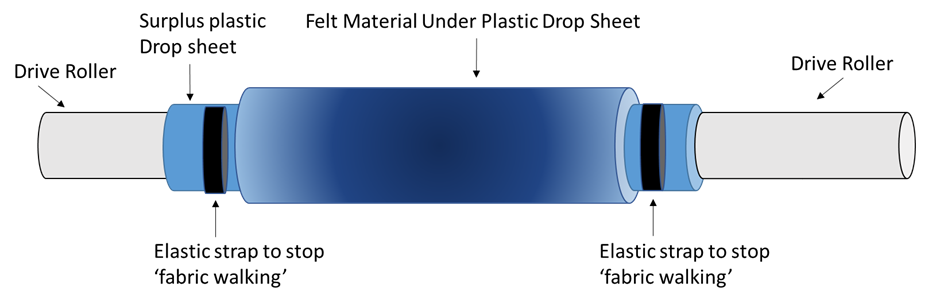
If there is excess loose plastic sheet at the end of the roller it can wrap itself around the red idle roller and pull the felt the wrong way which will ruin your felting. When it reverses direction, it untangles and your left wondering why the end felt is a mess.
Alternatively, the outer plastic sheeting gets wrapped around the idle rollers and jams the roller or throws it off the GR.
The problem and solution is quite simple. Ensure that the surplus plastic sheet is held down with an elastic band or elastic strap and is secure and unable to contact the idle roller. It will also stop your felt ‘walking’ toward one end or the other.
Q13 The Drive Roller keeps pulling the Hex Drive out and it is annoying.
If the drive roller disengages the hex drive when you remove the drive roller, the issue is with your technique. The drive roller is grabbing the hex because you’re lifting or tilting the left side (hex side) too early. When it is loaded in the GR the method to remember is;
(TAKE THE WEIGHT OF THE ROLLER) LEFT, RIGHT, LIFT and drag the RIGHT
Take the weight of the roller, hold it horizontally, move it hard to the left – maybe 10‐15mm (the hex moves left also as far as it can).
Move the Roller hard to the right – maybe 10-15mm (leaving the hex drive at the ‘hard left’. If the hex moves to the right, you’re not taking the weight, you’re dragging it, start again).
When you are hard right, a max 10mm of the roller is still inside the hex drive. This is good.
Lift the RIGHT-HAND side – while dragging the right side plastic end cap up against the right-hand end panel.
Don’t lift the left side.
While the right side is lifting/dragging, keep the left side at the original height and just move it horizontally 10mm until it is free of the hex.
It’s only needs to move 10mm to the right side to clear the hex. If the right side is touching the right end panel, it will easily clear the hex.
Practice with an empty roller. It’s easy to see what you are doing and see if you are dragging the hex to the right – which you need to avoid.
So, to repeat, take the weight, hold horizontally, hard LEFT, move horizontally RIGHT (the roller, not the hex). LIFT THE RIGHT END (slide it up the wall), while the left end is still going horizontally to the right.
There is a video on this in the Exclusive pages.
Q14 Tell me again when do I use the Firm Feel Drive Roller and when do I use the Soft Feel Drive Roller?
The firm feel comes as standard and will do anything, but is particularly useful for heavier items, like a coat or sleeved top or any garment that needs a resist and folding to fit on the roller.
If you are folding a garment with a resist you need to roll at least 4 layers of wool, 2 resists, and probably 4 layers of the outer fabric. It’s quite thick and heavy. When I designed the GR it was the basis for the original drive roller. Later it also proved to be very successful for doing wool rugs, or woollen fleeces when doing ‘eco’ sheep fleece rugs.
Soon after launching the GR, we turned to lightweight scarves and wraps – 15gm of wool, laid on 3mts of fine mesh silk. While they could be done on the Firm Feel Drive Roller, it didn’t seem to be the best solution. Bubble wrap proved a useful way for turning a Firm Feel Drive Roller into a de-facto Soft Feel Idle Roller (there is a video on that), but it wasn’t efficient to keep changing from a Firm to a Soft Drive Roller.
So I experimented with softer PU foam and came up with the Soft Feel Drive Roller. The sponginess of the foam roller allowed for easier migrating of wool thru silk, thus being quicker than the Firm Feel roller. Plus, the softer roller gave softer finish to the lightweight wool, it had less movement of embellishments and it was also a significantly lighter roller to handle.
Bottom line, if you are doing thick felt layers or very heavy felts or felts with a resist, use the (grey) Firm Feel Drive Roller. If you are doing very fine, light weight items, use the (purple) Soft Feel Drive Roller.
So, thick/heavy felts, wall arts, multi layered garments, something with a resist, rugs. etc use heavy = Firm Drive Roller;
thin, light weight felts = Soft Drive Roller
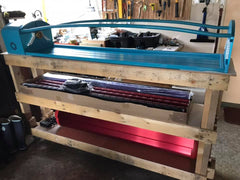
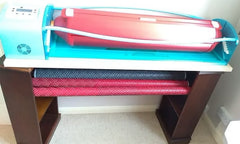
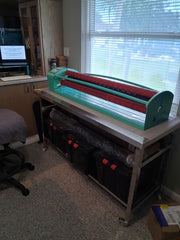
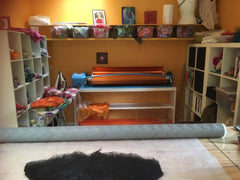
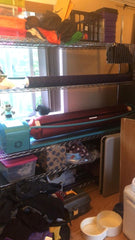
Q15 Do you have any space saving tricks as my studio is small and the GR is quite large.
Q16 The cartons came from China. Is the Gentle Roller Chinese?
No, it isn’t. It’s Australian. It is a product designed by Philip Coates; English born, Australian naturalized.. Philip designed all the components, sourced and approved all the tooling, and for the first few years even did the assembly albeit in Guangdong China.
With the experience of many years working in Asia, Philip realised that to achieve the cheapest global distribution costs the GR needed to be assembled and stored in China. Because it ‘ships’ from China, most countries consider it Chinese origin for the purposes of nominating an import status. They don’t look beyond the point of departure – China.
But the revenue received for the GR goes everywhere: to GR Australia (gentleroller.com.au), to various Australian suppliers of goods and services, to the GR China Office (gentleroller.cn), to various Chinese parts manufactures, to FedEx (a USA freight company), to multiple airlines depending on destination, and even to your country by way of the VAT/Tariffs/Duties/etc. they charge on arrival.
So, your payment goes far and wide. That is the nature of global trade, and it is good for everyone.
Like the pace-maker, the cochlear ear implant, wi-fi, ‘google’ maps, the combine harvester, the Victa lawnmower, the airline ‘black box”, the electric drill, and many, many more Australian inventions, these and the Gentle Roller are all Australian products that we kindly share internationally.